Abel D. Joe | u’i’pul’
August 17, 1914 – June 30, 1989
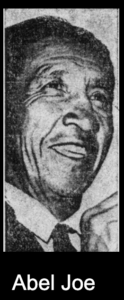
Abel Dominic Joe was a respected Elder, Knowledge Keeper, leader, singer, and storyteller from Quw’utsun First Nation. He was a fluent speaker of the Hul’q’umi’num’ language and generously shared his knowledge of the language, history, culture, music and traditions of his people with linguists and scholars including David Rozen, Wayne Suttles, Randy Bouchard and Dorothy Kennedy.
Abel Joe was born at Canoe Pass on the Fraser River in 1914 to parents Joe Smaquaset of Kwa’mutsun and Qaxulwut | Julia Schulseemum Joe of S’amunu.2 His grandfather was Suhiltun (Elwood Modeste’s father) and his siblings included Arthur Joe, Dominic Joe, Joe Joe, Maud Canute, Rita Point and Julia Thomas. From a young age, Abel learned traditional stories and cultural knowledge from his grandfather. As a young man, he married Lana James. Together the couple had two daughters, Glenda and Donna.
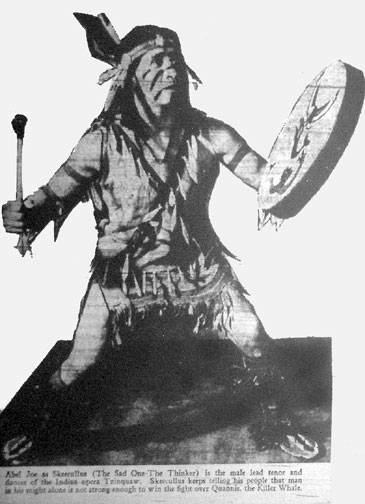
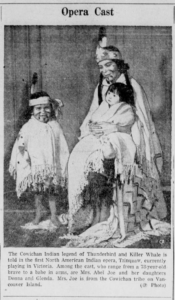
Abel Joe was an active member of his community, playing a significant role in leadership and language revitalization. He became well-known in British Columbia for his role in creating the Indigenous Opera, Tzinquaw. Partnering with Frank Morrison, a non-Indigenous (hwunitum’) man who worked as a music teacher at St. Catherine’s Indian School in Duncan, the duo created the Tzinquaw Opera in the 1940s.4 Abel shared his family songs with Morrison and introduced the music teacher to other Quw’utsun families. Together the two men developed a full opera based on the Quw’utsun Thunderbird story with songs inspired by traditional Quw’utsun music but written and sung in English. Abel sang lead tenor and his wife Lana, and their two daughters also took part in the opera.
Premiering in Duncan in 1950, the opera was an important Indigenous-Hwunitum’ collaboration at a time when racism towards Indigenous people was common and the Canadian government was actively engaged in assimilationist policies. The opera was created during a period when it was a criminal offence for Indigenous people in Canada to perform traditional songs and dances off-reserve.5 The Tzinquaw opera heightened awareness of Indigenous people in Canada in the 1950s and contributed to the public revitalization of Quw’utsun culture.
In addition to developing and performing in the opera, Abel Joe was actively involved in language and culture revitalization as well as the land claims process. Alongside other Elders from the Quw’utsun community, Abel visited school classrooms to provide language instruction to children.7 He also participated in an adult education lecture series sponsored by Malaspina College (now Vancouver Island University) and in cooperation with the school district. He shared his knowledge about Hul’q’umi’num’ language, dancing and costumes.8 Additionally, Abel served as the Native heritage advisor for two archaeological sites on Pender Island, actively participating in the excavations. In the mid-1970s he served as an elected council member for Cowichan Tribes.
In 1975 he, along with Abraham C. Joe and Joe Elliott, founded the Island Salish land claims committee.9 Initiated as a response to the Supreme Court of Canada’s 1973 Calder decision – that Indigenous land rights survived European settlement – and the launch of the federal government’s comprehensive claims policy, this committee worked to gather support for land claims among the Coast Salish people of southeast Vancouver Island. The group was able to get the involvement of First Nations from Saanich to Snuneymuxw, and their activities laid the groundwork for what became the Hul’q’umi’num’ Treaty Group.10
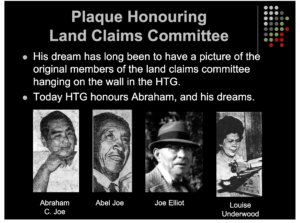
A leader in our community, he was a member of the Quw’utsun land claims committee alongside Abraham C. Joe, Joe Elliot, and Louise Underwood (as secretary). In the mid-1970s, Joe participated in a documentary by the Union of B.C. Indian Chiefs. He and his wife, Lana Joe, were interviewed for The Land is the Culture, produced for the Land Claims Research Centre of the Union of BC Indian Chiefs. Abel Joe was also an important resource for the Cowichan Land Claims committee. He shared his knowledge of Quw’utsun land use, occupancy, culture and traditions with scholars. He was an important informant to researchers David Rozen and Wayne Suttles and the information he shared is regularly drawn on today to support the Hul’q’umi’num’ Treaty Group’s land claims.
When he died in 1989 at the age of 74, he was widely recognized as a respected figure in the Cowichan Valley. Upon his death the MLA for the district of Cowichan-Malahat, Graham Preston Bruce, made mention of his passing to the British Columbia legislature, asking that the House send condolences to the Cowichan people for the loss of Abel Joe. Mr. Bruce said: “He worked long and hard in preserving — and educating people about — the Indian culture, and he was a leader in our community in the development of the great performance, the Indian opera Tzinquaw. I suppose you could say that as man he could sing like a bird, and if you looked at him and knew of him, the type of bird you would think of was not so much a robin or a sparrow, but more of an eagle, in the strength that he had as a man. He is truly a great loss to the Cowichan people, to our community, to our province and indeed to our country.”11
We are thankful for the important work Abel Joe carried out during his lifetime and are grateful for the knowledge repository his sharing created. Abel Joe’s actions led to the creation of the Hul’q’umi’num’ Treaty Group and to the Quw’utsun cultural performance group, The Tzinquaw Dancers.12 His commitment to cultural practice, Indigenous language and traditions, as well as the recognition of Indigenous rights continues to have a lasting impact today.
Related links
Abel Joe sings Catholic Mass Songs (link)
- Image source http://www.hulquminum.bc.ca/pubs/Abraham%20C%20Joe_honouring.pdf ↩︎
- Reference to parents found in his death certificate here: https://search-collections.royalbcmuseum.bc.ca/Image/Genealogy/a59b6c73-02fc-45f2-acbb-210ec9d5dd5c
In an interview with Chris Paul and Randy Bouchard, his grandfather’s name is recorded as Joe Duncan, a hwunitum (white man) and his mother’s Indigenous name as qaxulwut | Julia Joe (that was her maiden name). Find his mother’s death certificate here: https://search-collections.royalbcmuseum.bc.ca/Image/Genealogy/f3d4b481-914d-4e15-ab25-92535ed05ad4
See also https://grantkeddie.com/2024/10/31/butchering-sea-lions-with-stone-tools/; and “Abel Joe and Modeste_Names and Relations.pdf ↩︎ - Image source http://photos1.blogger.com/blogger/3377/2139/1600/tzinquawabeljoe1.1.jpg ↩︎
- The two began working on the opera in about 1942. The first production of Tzinquaw: The Thunderbird and the Killer Whale was performed at Cowichan High School in Duncan, November 22-25, 1950. https://mima.midislandmusicarchive.ca/index.php/Morrison,_Frank,_and_Abel_Joe ↩︎
- And traditional ceremonies like the Sundance and the potlatch were banned until 1951. ↩︎
- Image source https://numerique.banq.qc.ca/patrimoine/details/52327/2999522 ↩︎
- lhalhukw’ siiye’yu: An introduction to birds in the Hul’q’umi’num’ world, MA thesis, Siya’mulwut | Claudia Sylvester. https://hlcs.hwulmuhwqun.ca/2019-siyamulwut-claudia-sylvester-lhalhukw-siiyeyu-an-introduction-to-birds-in-the-hulquminum-world/ ↩︎
- See The Daily Colonist, January 6, 1971 https://archive.org/details/dailycolonist19710106/page/n33/mode/ ↩︎
- http://www.hulquminum.bc.ca/pubs/Abraham%20C%20Joe_honouring.pd ↩︎
- Brian Thom, http://www.web.uvic.ca/~bthom1/Media/pdfs/senses_of_place.pdf ↩︎
- Wednesday, July 5, 1989 https://www.leg.bc.ca/hansard-content/Debates/34th3rd/34p_03s_890705p.htm ↩︎
- In addition, Joe wrote a manuscript about the life of Tzouhalem, a notorious Quw’utsun figure from the nineteenth century. This manuscript became the basis of contemporary filmmaker Harold Joe’s film Tzouhalem, released in 2022. ↩︎